


I like how winter Perler bead patterns turn familiar seasonal shapes into simple, colorful designs.
This collection includes snowflakes and snowmen, along with other ideas that can add a cozy touch to a quiet afternoon of crafting.
I’ve included a mix of patterns, so you can choose a design that suits your time and the beads you have on hand.
Whether you’re looking for a small project or a more detailed winter scene, these ideas offer an easy place to start.
Symmetrical Blue and White Perler Bead Snowflake

This winter Perler bead pattern forms a large, symmetrical snowflake from individual white and blue fuse beads arranged on a pegboard. White beads create the branching outer arms, while turquoise sections define the center and repeat along each spoke, making the snowflake’s shape clear across the flat design. The stepped, mirrored arrangement gives the pattern its recognizable icy look without relying on extra details.
The symmetry makes this layout a useful starting point for creating matching snowflakes in different winter palettes, such as icy blue and silver-toned beads or white with deeper blue accents. To simplify the pattern, use fewer color changes along the arms; for a more varied set, keep the same branching shape and change the colors or center design.
Snowman Perler Bead Pattern with a Red Hat

This winter Perler bead pattern forms a snowman from individual white, black, red, and orange fuse beads arranged on a pegboard. The stacked white sections create a clear snowman silhouette, while the black hat, red band and scarf, and orange carrot nose make the details easy to recognize in a flat, pixel-style design.
The strong color blocks make this pattern a useful starting point for other winter bead designs. Change the hat or scarf colors to create variations, or simplify the face and scarf details for a more compact snowman pattern.
Snowman Perler Bead Pattern with a Green Hat
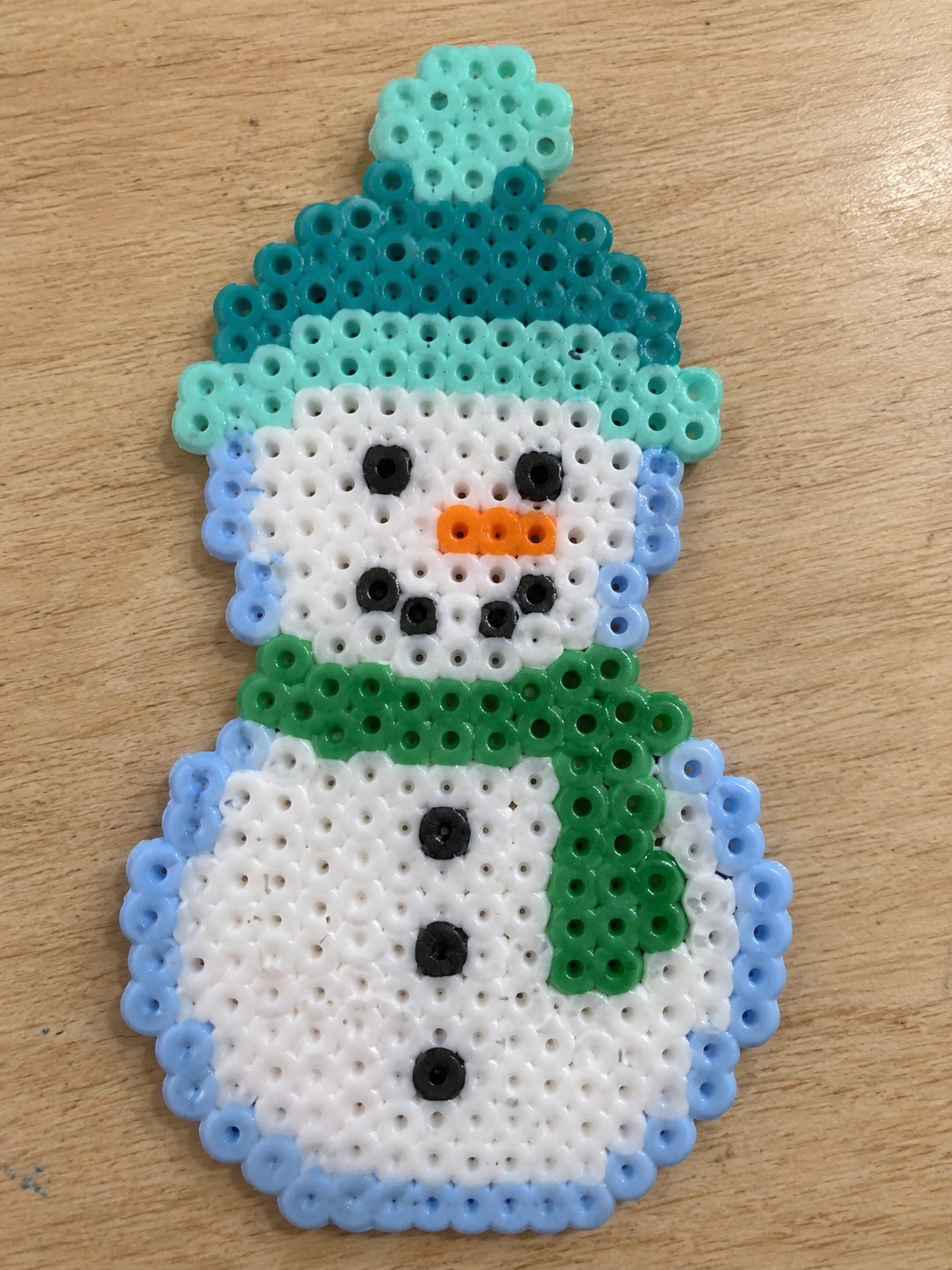
This flat winter Perler bead design forms a snowman with a rounded body, a white face, black eyes and buttons, and a small orange nose. Individual beads create stepped edges around the snowman, while the dark teal hat and green scarf stand out against the light blue outline and white body.
The clear color blocks make the snowman’s features easy to distinguish and offer a useful starting point for a matching winter set. Try changing the hat or scarf colors, or adjust the facial details to give each snowman a different expression. The finished fused shape could work as a seasonal display accent or, if its size and edge suit it, a simple ornament.
Snowflake Perler Bead Pattern in Blue and Purple

This winter Perler bead pattern uses blue and purple fuse beads to form a large, branching snowflake with a stepped, pixel-like outline. The branches radiate from a compact center, while the alternating colors help separate the shape’s arms and make the snowflake easy to recognize. A smaller white snowflake pattern nearby offers a simpler variation on the same seasonal motif.
The branching layout is a useful starting point for making a matching set: keep the basic snowflake shape and change the colors, or adjust the arm lengths to create different silhouettes. For a less detailed version, use fewer color changes and shorter branches; adding extra bead colors can give a larger pattern more definition. The beads are still arranged on pegboards, so the patterns need to be fused before they can be handled as finished pieces.
Teal and White Perler Bead Snowflakes

This winter Perler bead design pairs a large teal snowflake pattern with a separate white snowflake, using individual fuse beads arranged in clear, symmetrical branches. White bead clusters stand out against the teal field, while the smaller all-white shape keeps the classic six-armed snowflake silhouette easy to recognize. The pieces are still bead arrangements rather than fused decorations.
The contrast makes the larger pattern readable while leaving room to experiment with different shades of blue, white, or lavender. For a coordinating set, keep the same branching shapes and vary the background color, or simplify the larger design by using fewer white accents. The two flat patterns could also be fused separately for a winter display.
Pink-Hatted Snowman Perler Bead Pattern

This flat snowman pattern uses individual physical fuse beads arranged on a pegboard, with a rounded white body and a pink hat and side details. Black beads define the eyes and buttons, while a short orange row forms the nose, making the face easy to read against the white beads. Purple bands add a contrasting section between the snowman’s head and body.
The clear color blocks make this winter pattern easy to adapt: swap the pink for red, green, or blue, or change the purple section to create a coordinated set of snowmen. For a simpler version, use fewer colors and omit some body details. The arranged beads would need to be fused before the design could be handled as a finished craft.
Hanging Blue and White Perler Bead Snowflake Ornament

This flat Perler bead snowflake ornament uses a balanced, six-armed layout, with small white beads outlining the branches and blue beads creating accents through the center and tips. The repeating shapes and strong color contrast make the snowflake easy to recognize, while the visible cord loop gives the finished design a clear hanging use.
The symmetrical arrangement makes a useful starting point for a winter bead pattern, and swapping in pale purple or icy shades would change the look without altering the basic shape. Try repeating the design in a few color combinations for a coordinated set of tree or window ornaments.
Three Winter Perler Bead Designs in Coordinated Colors
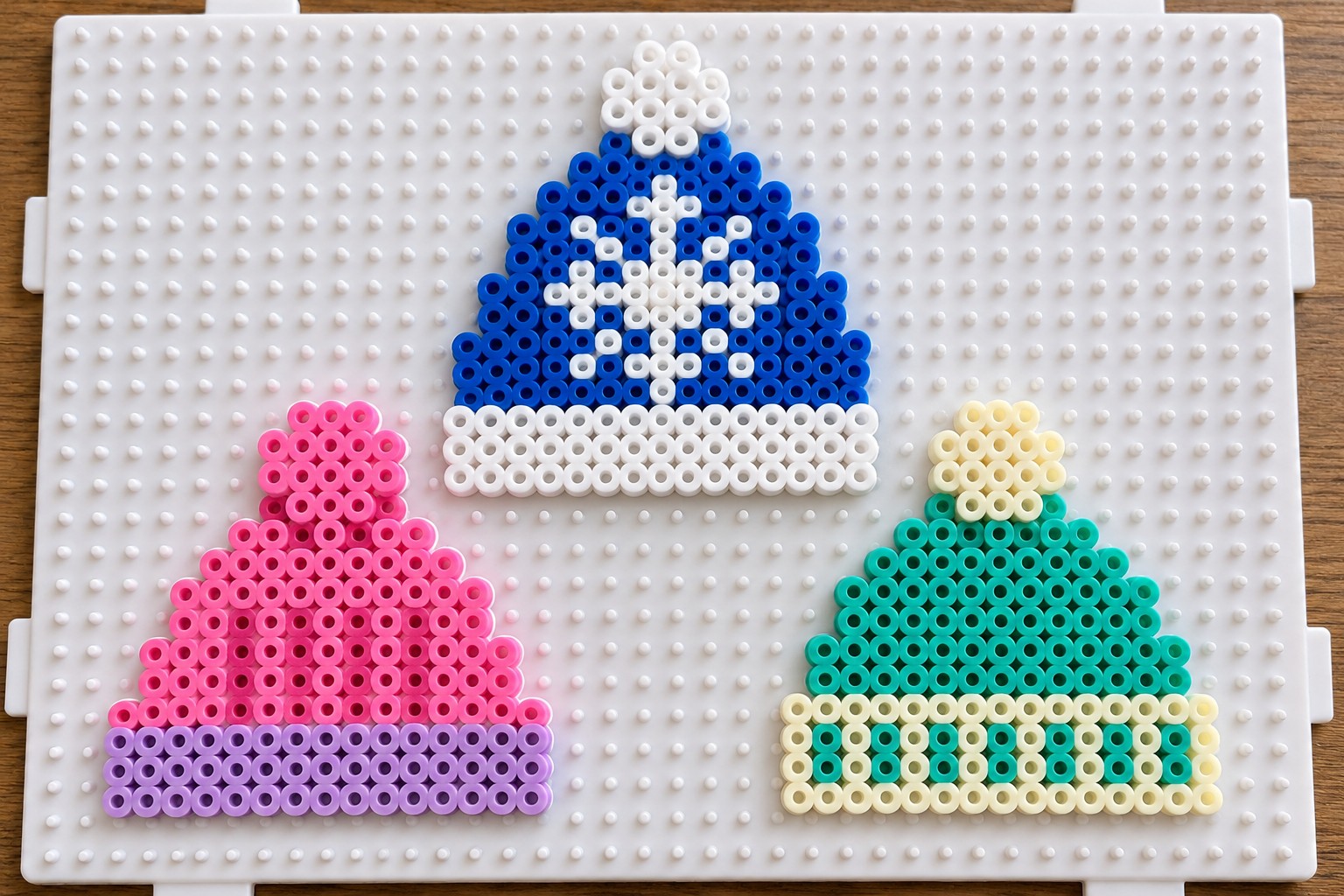
This physical Perler bead set combines three flat winter patterns: a blue-and-white snowman with a round hat, a pink snowman with a purple brim, and a teal snowman with a pale yellow hat and band. Stepped bead silhouettes shape each figure, while contrasting hat colors and white facial details keep the designs distinct on the pegboard.
The shared snowman shape makes these patterns easy to coordinate without making them identical. Try swapping the hat and body colors for a matching set, or reduce the smaller face details if you want to simplify one of the layouts.
Snowman Perler Bead Pattern with a Red Scarf

This physical Perler bead snowman pattern uses a stepped black outline to define its rounded body, with white beads forming the face and snow-covered shape. Red and teal color blocks make a striped scarf stand out, while the small orange nose gives the face a clear focal point. The design is arranged as a flat, pixel-like pattern on a pegboard, with individual beads placed to build the snowman’s features and clothing.
The contrasting scarf colors make it easy to adapt the pattern into other winter color schemes, or to simplify it by using just one accent color. For a coordinating set, keep the same snowman shape and vary the scarf colors or facial details. The flat silhouette could also be finished as a seasonal display piece.
Matching Blue and White Perler Bead Snowmen
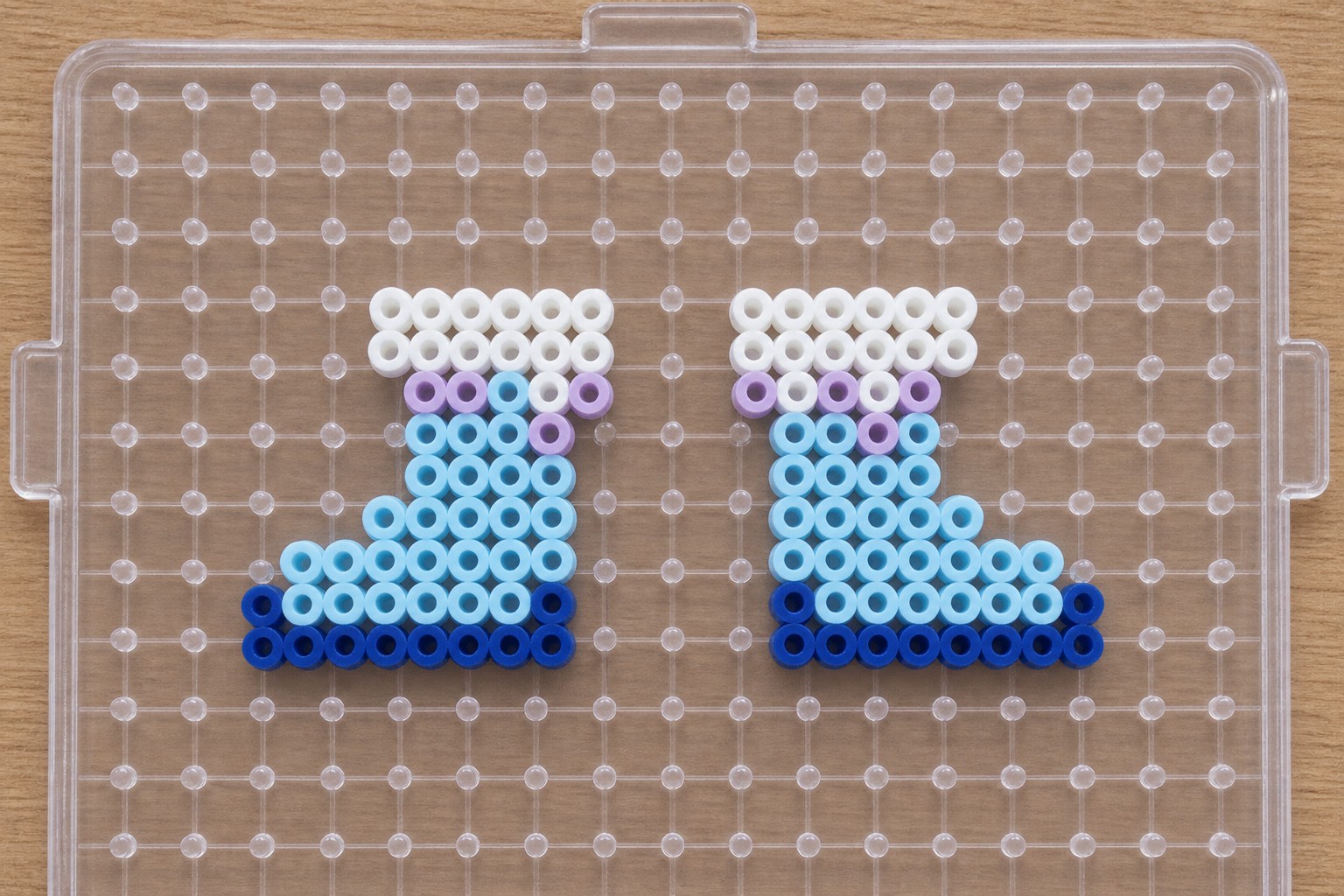
Two compact snowman patterns use white bead rows for their heads and blue beads to build stepped bodies, with dark blue along the bottom as a strong outline. Small purple accents add a bit of color near the top, while the different body shapes give the pair slightly varied silhouettes. The unfused beads are arranged as flat patterns on a pegboard, not assembled into dimensional figures.
The clear color blocks make the snowmen recognizable without relying on tiny facial details, so the same layout could be adapted with different scarf or hat colors. Try changing the purple accents to red, green, or another winter shade, or adjust the body widths to create a coordinated set of snowmen with distinct silhouettes.
Orange-Nosed Snowman Perler Bead Pattern

This snowman is arranged from individual white fuse beads in a rounded, stepped silhouette, with black beads marking the eyes, buttons, and smile. A small cluster of orange beads forms a carrot-like nose, giving the face a clear focal point while keeping the pattern readable on the pegboard.
The strong contrast between the white body and dark facial details helps the snowman stand out, and the same layout could be adapted with a colored hat or scarf if you want to add a winter accessory. Keep the black features and orange nose for easy recognition, or change their placement slightly to create a set of snowmen with different expressions.
Blue Icicle Perler Bead Snowflake

This winter Perler bead pattern pairs a white, six-armed snowflake with a wide blue band that tapers into three dangling icicles. Individual fuse beads create rounded, stepped edges, while the white center and graduated light-to-deep blue sections keep the snowflake and hanging icicle shapes easy to distinguish. The connected design is a flat decorative piece rather than a dimensional construction.
The icicle band gives this pattern a different look from a standard snowflake and offers a clear starting point for color variations. Try pale blue and white for a frosty palette, or adjust the shades along the icicles to make their tapered shapes stand out; the symmetrical white snowflake can remain the focal point.
Brown Reindeer Perler Bead Pattern with a Blue Scarf

This winter Perler bead pattern forms a standing reindeer from individual brown, orange-brown, cream, red, and blue beads arranged on a pegboard. Its antlers, cream muzzle, dark eye, and stepped body outline make the animal recognizable, while the red-and-blue section adds a bold scarf-like accent. The piece is a flat bead arrangement, not a dimensional construction.
The contrasting cream face helps define the reindeer’s head, and the strong color blocks keep the silhouette readable across the larger pattern. To adapt it, change the scarf colors or use a lighter brown for the body, while keeping the antlers and muzzle distinct. A smaller version could simplify the body and legs while retaining those key features.
Large Blue and White Perler Bead Snowflake with a Purple Variation

These physical Perler bead patterns use branching, symmetrical arms to create two snowflakes: a larger white snowflake with light-blue tips and a smaller purple design with a white center. The repeated bead clusters and contrasting colors make each six-armed shape easy to read, while the layered-looking branches add detail to the flat arrangement. Both designs are still arranged on the work surface rather than fused.
The repeating arm pattern gives you a clear structure to adapt with icy blue, teal, or other winter colors. For a simpler version, use fewer bead clusters along each arm, or make a coordinated set by keeping the same outline and changing the color placement. Once fused, these flat snowflakes could work as seasonal display accents or ornaments if you add a suitable hanging method.
Snowman Perler Bead Pattern with a Green Hat and Blue Snowflake

This winter Perler bead pattern pairs a pixel-style snowman with a separate blue snowflake. The snowman’s stepped green hat, white body, red clothing, black facial details, and orange nose create clear color blocks that keep the character recognizable, while the snowflake adds a contrasting seasonal motif. Both designs are individual beads arranged on a pegboard, not yet fused.
The contrasting colors make the snowman easy to distinguish from the snowflake, and the hat and clothing offer simple ways to change the palette for a coordinated winter set. You could also make matching snowflakes in different shades of blue or simplify the snowman by reducing small facial and clothing details.
Two Winter Mitten Perler Bead Designs
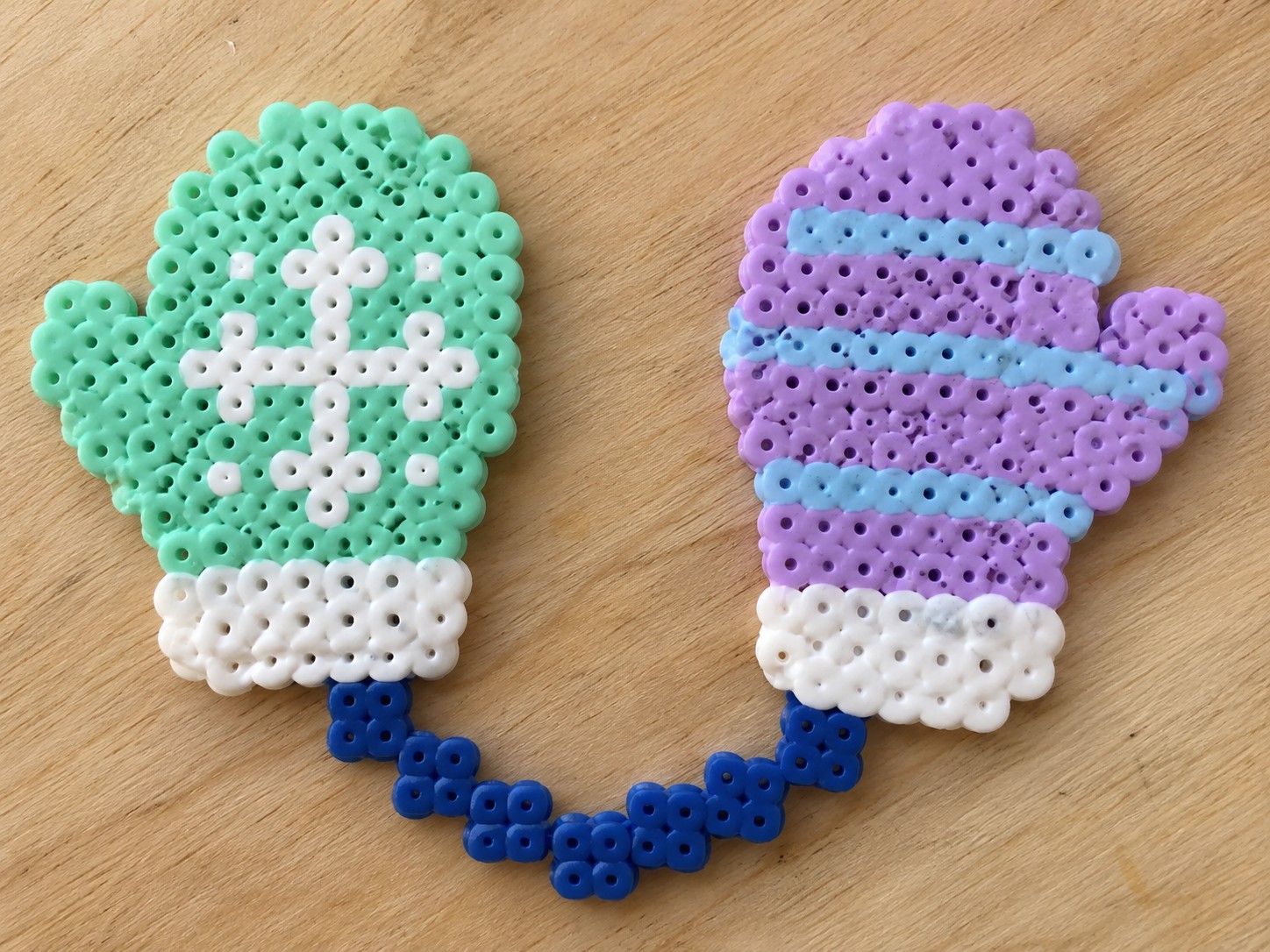
These two flat Perler bead mitten patterns use stepped silhouettes to create a pair of recognizable winter accessories. Individual mint-green and purple beads form the mittens, while white cuffs and contrasting white or light-blue stripes make the patterns stand out; the green mitten also has a simple snowflake-like motif.
The clear color blocks make these patterns easy to adapt into a coordinated pair, using different mitten colors or swapping the stripe shades to match a winter palette. You could also simplify the designs by leaving out the smaller motifs, or make a matching set with several color combinations.
Purple and White Perler Bead Snowflake Pattern
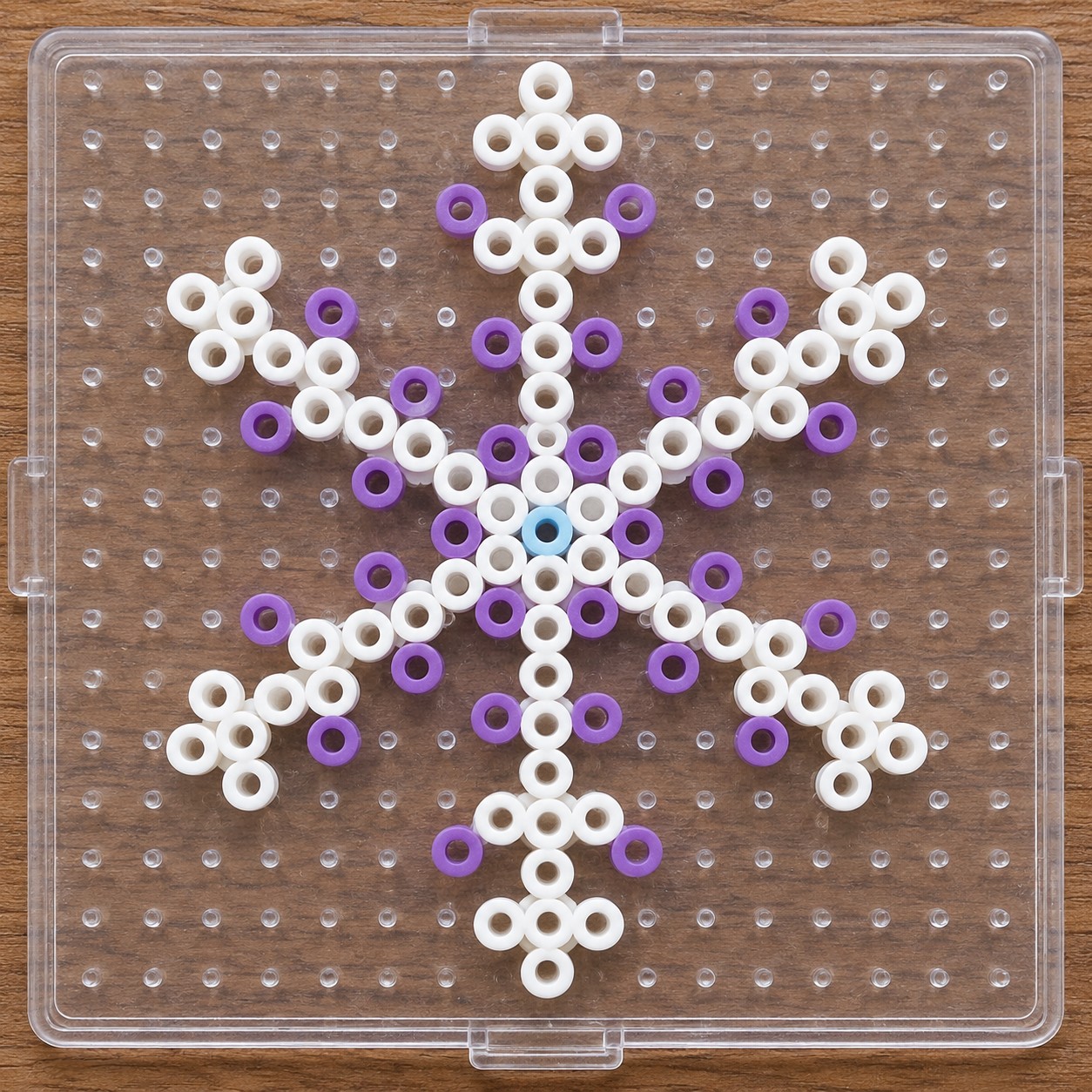
This winter Perler bead pattern forms a large, symmetrical snowflake from individual white and purple fuse beads, with a single blue bead marking the center. White beads create the branching arms and stepped tips, while purple beads add contrast at regular intervals so the snowflake’s shape reads clearly as a flat, grid-based design on the pegboard.
The repeating branches make the pattern a useful starting point for other snowflake variations. Swap in icy blue or teal beads, or reduce the purple accents for a simpler palette while keeping the white outline and balanced shape.
Snowflake and Snowman Perler Bead Pattern Set

This winter Perler bead set pairs two blue-and-white snowflakes with a teal-trimmed snowman and a pink-hatted snowman. Each design is arranged from individual physical fuse beads on a pegboard, with stepped, roughly symmetrical shapes that make the snowflakes recognizable and contrasting color blocks that define the snowmen’s hats, faces, scarves, and details.
The repeated snowflake shape makes the set easy to adapt with different shades of blue or a new winter palette, while the two snowmen offer a starting point for changing hat and scarf colors. Keep the facial features and silhouettes, but use fewer accent colors to simplify a version, or add bead colors to make the clothing patterns more detailed.
Frequently Asked Questions
You’ll need Perler beads in winter colors, a pegboard, ironing paper, and an iron. Tweezers can make small details easier to place, especially on snowflakes. Choose white, light blue, dark blue, and silver or gray for classic designs, then add bright colors for scarves, hats, or other playful accents. A flat, heat-safe surface is also helpful for ironing.
Start by finding the center of your pegboard and build the snowflake outward one section at a time. Make one arm, then repeat its bead arrangement on the opposite side. Rotate your pattern as you work so you can compare each arm with the others. A printed or digital grid pattern can help you keep the spacing consistent.
Use contrasting bead colors to make the snowman’s features stand out. Add a bright scarf, a dark hat, small buttons, and a colored nose. You can also create details such as earmuffs, a broom, or a snowy base. For a small design, keep the features simple so they remain clear after ironing.
Place ironing paper over the beads and use a dry iron on a medium setting. Move it gently in small circles, checking the design often. Stop once the beads have fused enough to hold together, rather than pressing until the holes disappear. Let the design cool before removing it from the pegboard, then iron the other side if you want extra strength.
Turn them into ornaments by adding a ribbon or thread through a bead opening. Small designs also work as gift tags, magnets, pins, or decorations for cards and winter displays. For ornaments, make sure the beads are securely fused and attach the hanger to a sturdy part of the design.
